A face scrub isn’t the only way to exfoliate. Exfoliation helps lift dead skin cells from the skin’s surface, either through physical friction or ingredients that loosen buildup. A scrub & exfoliator can refer to different approaches: a scrub uses particles or a textured surface, while an exfoliating cleanser combines cleansing with exfoliation.
A more noticeable scrub may seem more effective, but facial skin often benefits from a gentler touch. The right choice depends on your skin’s sensitivity, the formula, and how you use it.
This guide explains how to exfoliate your face, compares scrubs with exfoliating cleansers and other options, and shows how to compare product sizes and prices. You’ll also find a simple guide to choosing an approach that feels comfortable and fits your routine.
Key Takeaways
- Match exfoliation to your skin’s sensitivity and concern, then use a gentle approach that feels comfortable.
- Compare physical scrubs with chemical formulas, and learn the over-the-counter salicylic acid limit stated by the U.S. Food and Drug Administration.
- Assess product size alongside price and formula so you can judge which option best suits your routine.
- Explore how face scrubs and exfoliating cleansers differ, and where a rice peeling ampoule may fit into your care routine.
How to exfoliate your face?
Choose a method based on your skin type and concern, then use it gently. AHA formulas, physical scrubs, and exfoliating cleansers work in different ways.
Exfoliators for Different Skin Types
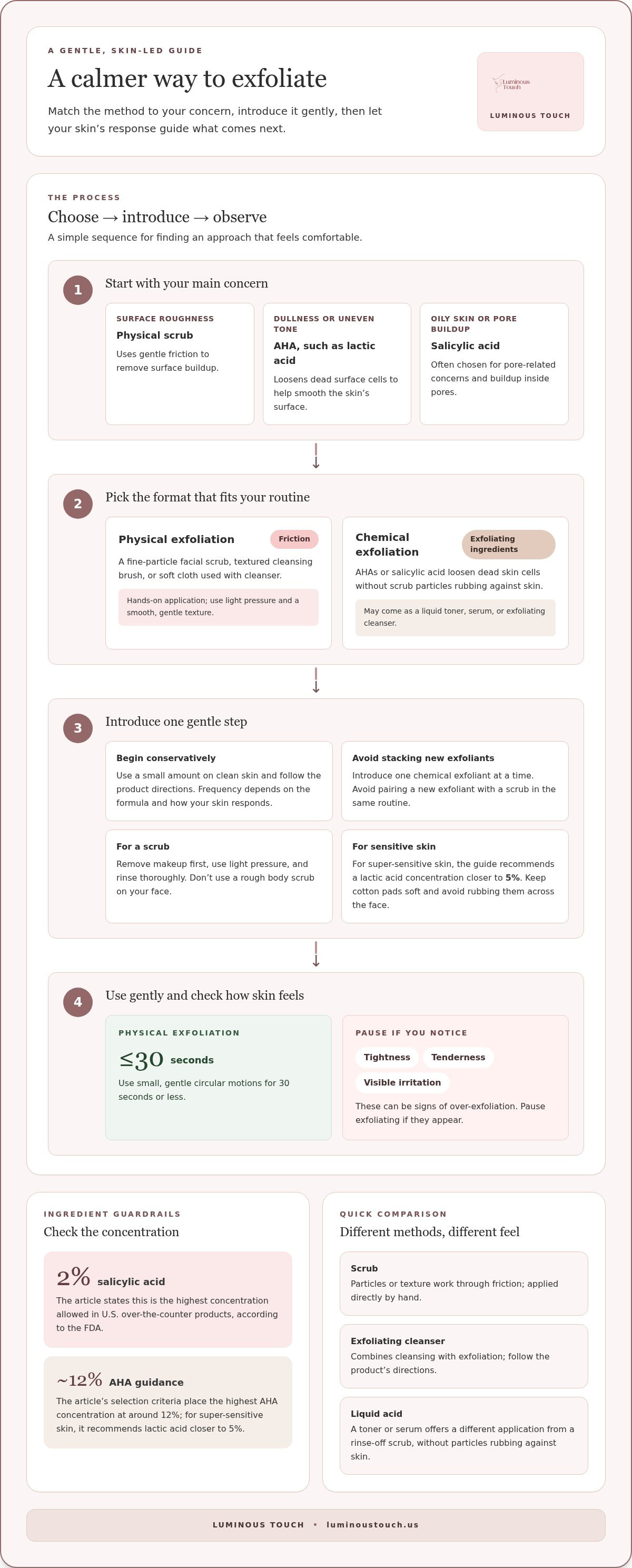
For oily skin, a formula with salicylic acid may target buildup inside pores; dry or dull skin may suit an AHA such as lactic acid. Physical scrubs remove dead skin cells through friction, while acids loosen surface buildup without scrub particles. Choose according to your concern and how your skin responds.
| Option | Best fit | How it works |
|---|---|---|
| Physical scrub | Surface roughness | Gentle friction |
| AHA | Dullness, uneven tone | Loosens surface cells |
| Salicylic acid | Oily skin, pore buildup | Targets pore congestion |
Start with your main concern, then choose the gentlest option your skin tolerates.
Exfoliation for Dullness and Uneven Skin Tone
For a dull appearance or uneven tone, an alpha hydroxy acid can help smooth the skin’s surface by loosening dead skin cells. Lactic acid is an AHA option; for super-sensitive skin, choose a concentration closer to 5%. Selection criteria set the highest AHA concentration at around 12%. Introduce one exfoliating formula rather than combining products immediately.
Starting Exfoliation for Sensitive Skin
Start with a gentle formula and use a small amount on clean skin, following its directions. For super-sensitive skin, lactic acid closer to 5% is the recommended concentration. Avoid pairing a new exfoliant with a scrub in the same routine; that makes it harder to tell which step is causing discomfort. Keep cotton pads soft and avoid rubbing them across the face.
Exfoliation Frequency and Over-Exfoliation Risks
How often should you use a scrub or exfoliator? It depends on the formula and your skin’s response, so begin conservatively and adjust only when your skin remains comfortable. For physical exfoliation, use small, gentle circular motions for 30 seconds or less. Over-exfoliation can leave skin feeling tight, tender or visibly irritated; pause exfoliating if these signs appear.
Chemical and physical face exfoliators
A body scrub is a physical exfoliator, while “exfoliator” also includes chemical formulas. Face and body options include scrubs, cleansing tools, and liquid products with exfoliating acids.
Chemical Face Exfoliators
Chemical exfoliators use ingredients such as alpha hydroxy acids (AHAs) or salicylic acid to loosen dead skin cells across or within the skin’s surface. A liquid toner or serum can offer a different application from a rinse-off scrub, without particles rubbing against the skin. According to the U.S. Food and Drug Administration, 2% is the highest concentration of salicylic acid allowed in over-the-counter products.
AHAs, including lactic and glycolic acid, can help smooth the skin’s surface and improve the look of dull texture. Salicylic acid is often chosen for oily skin and pore-related concerns. Read the ingredient label, follow the product directions, and introduce one chemical exfoliant at a time. This makes it easier to notice how your skin responds.
Physical Face Exfoliators
Physical exfoliators remove surface buildup through friction. Examples include a facial scrub with fine particles, a textured cleansing brush, or a soft cloth used with cleanser. Unlike an acid formula, a physical option relies on contact and movement rather than exfoliating ingredients. Use light pressure, especially around delicate areas, and don’t use a rough body scrub on your face.
Remove makeup before using a scrub so it can reach your skin rather than sitting on top of cosmetics. Choose a smooth, gentle texture and rinse thoroughly. A brush adds a reusable tool to your routine, while a scrub is applied directly by hand. Either way, forceful rubbing can leave your skin uncomfortable.
To compare options, consider where the formula is intended to be used, how it exfoliates, and whether its format suits your routine. A liquid acid may fit a targeted skincare step; a physical scrub combines exfoliation with hands-on application. For body care, choose a product made for that area rather than assuming a face formula will meet every need.
Explore the scrub and exfoliator options to compare formats and find one that matches your preferred approach.
Exfoliator pricing and product sizes
Exfoliator prices vary with format, ingredients, package size, and how the formula is used. Market sampling collected October 23, 2026, puts exfoliating pads between $24 and $42, with a median about $32. That range reflects four offers from four sources, so treat it as a snapshot for pads, not a universal price for every exfoliator.
Compare package sizes before judging value. Check the net weight or fluid volume, then divide the listed price by that amount to compare similar formats. A jar of scrub, a bottle of liquid exfoliant, and a pack of cotton pads may contain different amounts and serve different purposes. The format that fits your routine can matter as much as the amount inside.
Read the ingredient list as well as the size. An AHA formula may contain lactic or glycolic acid, while a physical scrub relies on particles and texture. “Natural” on a label doesn’t automatically mean gentler; the full formula and your skin’s response matter. Choose a product for your main concern, such as rough texture or dullness, rather than paying for ingredients you don’t need.
- For a liquid formula: Compare its listed volume and directions, then consider whether it suits your existing routine.
- For pads: Check the number of pads and how the maker directs you to use them; the market range above applies to this format.
- For a scrub: Review the texture and intended use, since particle type can affect how it feels during application.
Face scrubs and exfoliating cleansers
Face scrubs and exfoliating cleansers can both fit into a cleansing routine, but they do different jobs. A scrub uses friction to lift surface buildup; an exfoliating cleanser may use acids or particles while washing away makeup and residue.
The skin’s natural exfoliation process generally takes about a month. A cleanser removes oil, makeup, and daily grime; an exfoliating cleanser adds an active ingredient or texture to that step. A scrub focuses on manual polishing instead. Choose based on whether you prefer a single cleansing step or a separate product applied by hand.
Use either product on damp skin, following its directions. Apply a scrub with light pressure and small circular motions, then rinse completely. With an exfoliating cleanser, check whether it’s meant to be rinsed off, and don’t leave it on like a serum. When introducing a new product, avoid combining several exfoliating actives in one routine so it’s easier to identify the cause if irritation occurs.
- Choose a scrub if you prefer a tactile product and can use it gently without pressing or dragging across your face.
- Choose an exfoliating cleanser if you want cleansing and exfoliation in one step. Check its ingredient list for an active such as an AHA.
- Choose a regular cleanser if your priority is removing makeup and residue without adding exfoliation to that wash.
After rinsing, apply moisturizer or lotion as part of your usual routine. If you use a separate exfoliating active, keep cleansing simple and follow that product’s directions. The key difference is function: a scrub exfoliates through touch, while an exfoliating cleanser combines cleansing with an exfoliating ingredient or texture. Choose one approach, notice how your skin feels, and adjust before adding another exfoliating step.
Luminous Touch: Dr. Melaxin Collagen Boosting Serum
After choosing an exfoliation approach, consider Dr. Melaxin Collagen Boosting Serum as a separate skincare step. Keep your routine focused: use an exfoliant according to its directions, then apply the serum rather than layering several exfoliating products at once. A simpler routine makes it easier to follow each step and notice how your skin responds.
If you’re specifically looking for a peeling product, Dr. Melaxin Radiance Boost Rice Peeling Ampoule and Medicube Hydrating Facial & Body Peel Shot Duo are other options in the range. Choose based on whether you want a serum step or a peeling-focused product, and avoid treating them as interchangeable. Luminous Touch also offers the 5-in-1 Face Sculpting & Skin Care Device for a device-based skincare routine.
For product details, contact Luminous Touch.
Build a Routine That Feels Right
Make exfoliation part of a skincare routine you can follow consistently. Consider what you want to address, how your skin feels after cleansing, and whether an added exfoliating step feels comfortable alongside your other products. A thoughtful choice is more useful than frequently switching formulas or layering several active ingredients at once.
As your routine evolves, pay attention to how your skin responds and adjust one step at a time. That simple approach can help you identify the scrub & exfoliator format that feels most suitable, without making your skincare unnecessarily complicated. For a closer look at available options, explore scrub and exfoliator choices.
Choose carefully, keep your routine comfortable, and let each step support the fresh, balanced complexion you’re working toward.
Frequently Asked Questions
What does exfoliate mean?
To exfoliate means to help clear dead cells and buildup from the outer skin surface. Your skin naturally sheds cells as part of its renewal process; an exfoliating product supports this surface-clearing step. A cleanser with an exfoliating ingredient works differently from a textured scrub, but both are intended to refine how your skin feels.
What are chemical exfoliators?
Chemical exfoliators use active ingredients to loosen the bonds between surface cells rather than relying on scrubbing motions. Examples include alpha hydroxy acids such as glycolic acid and lactic acid, and beta hydroxy acids such as salicylic acid. They’re found in products like toners, serums, and cleansers. Follow the directions for the specific product, since formulas differ in strength and use.
What are physical exfoliators?
Physical exfoliators remove surface buildup through gentle contact and movement. Examples include face scrubs with particles, soft cleansing cloths, and facial brushes used with cleanser. Their effect depends partly on texture and pressure. Use a light touch and avoid rough, forceful rubbing; a tool or scrub should feel comfortable, not abrasive or painful.
What does exfoliating do to your skin?
Exfoliation helps lift accumulated dead cells from the surface, which can leave skin feeling smoother and looking less dull. It may also help skincare products spread more evenly over freshly cleansed skin. Results depend on the product and your skin’s response. Exfoliation doesn’t replace cleansing or moisturizing, and using more product doesn’t automatically improve results.
How do you exfoliate your face and body safely?
Start with clean skin, choose a product made for the area, and follow its label directions. Use a gentle touch on your face, especially around delicate areas; body products may have a different texture and purpose. Rinse products meant to be rinsed off, then apply moisturizer. Introduce one exfoliating product at a time so you can notice discomfort and adjust.
What ingredients should you look for in a scrub or exfoliator?
Choose ingredients based on your main concern and preferred format. Glycolic or lactic acid are examples of AHAs, while salicylic acid is another common exfoliating ingredient. Physical scrubs use particles, so check the texture and intended use. Read the full ingredient list, and don’t choose a formula based only on words like “natural” or “brightening.”